
The Goodness Coming Out
On wearing things until they're part of you.

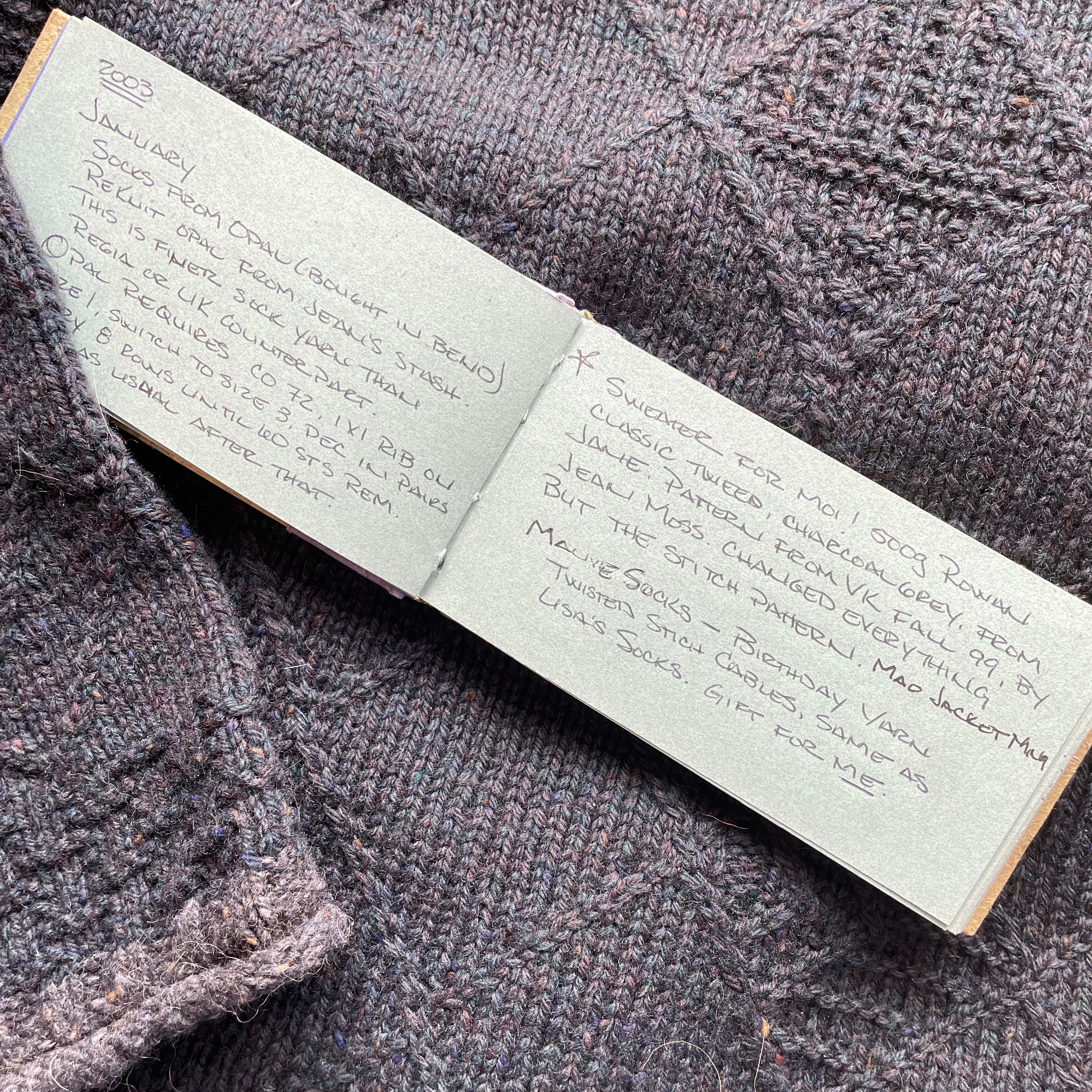
I’m wearing a sweater I made in January 2003. I know the date because I found my project notes in a tiny hand-bound book my sister Pam gave me, from the days before Ravelry, when we tracked our projects in notebooks and trusted ourselves to remember the rest.
The pattern was Jean Moss’s Mao Jacket Ming, from Vogue Knitting Fall 1999. In the magazine it was red, with black I-cord trim at the collar and cuffs, and frog closures made from the same I-cord. The design featured one of those stand-up collars that look fabulous on women with swan-like necks. I am not a woman with a swan-like neck. I changed everything. Cardigan became pullover. Collar removed. Broken rib at the cuffs and hem. The only thing I kept was the stitch pattern; a trellis of diamond shapes made from single stitch cable crosses, with knit and purl patterns nestled inside some of the diamonds like small gifts. Gansey stitches, mostly, but a few with tiny cables. It was fun to knit. There was always something happening on my needles. That’s what kept me at it.


The yarn was Rowan Classic Tweed. I had 500 grams and used nearly all of it. Maybe ten to twelve grams left over. I wound the remainder into a butterfly and set it aside for mending, not knowing I wouldn’t need it for twenty years. Can I find it now? Of course not. But I know it’s somewhere. I wouldn’t have thrown it away.
This is the thing about knitters. Hand us a small butterfly of yarn from a decades-old project and we know exactly what the project was. Not just the technical details; the needle size, the gauge, the construction. But where we were when we knit it. How we felt. The decisions we made. A butterfly of yarn is a flood of memory in twelve grams of wool.
The fit of the completed garment is not great. It was early days in my sweater knitting career; maybe my sixth or seventh. I was still learning about shaping. The sweater is boxy, because it was the nineties and everything was boxy. The sleeves are a little too short. The neck is a little too wide and back neck should be deeper; the back of the sweater rides up and I hate that about it. But it’s behind me, so I don’t look. I just don’t look at it. Nobody notices the fit except me. Probably.
A yarn shop owner I knew once had an answer for knitters who came in complaining about yarn pilling. “That’s just the goodness coming out.” The goodness came out of my sweater a long time ago. What’s left is a soft fabric that feels thin. The wool has lost its loft. Tonia told me the elbows are wearing through. I took her word for it; I didn’t check. I should have checked. She’s right. They’re threadbare. Not holed yet, but close.
The cuffs went first. The bind-off came out of both sleeves. Without that elusive butterfly, I ordered yarn online that looked close enough. It isn’t really. A warmer grey. Not horrible, but not a match. I ran a thin circular needle through the stitches, clipped the yarn, unpicked a round, and knit new ribbing downward, adding the inch of length the sleeves have always needed. Mending as improvement. I’ll take it.


I still wear it. It’s one of the sweaters I reach for most often. Comfortable in that way old sweaters become comfortable. Like friends who’ve stopped trying to impress you. Now that I’ve actually looked at the elbows, I can see it’s become shabby, and it’s only going to get shabbier. I’ve known this was coming all winter. Ever since it went at the cuffs. I’ve been thinking about its successor.
Three questions I ask at the planning stages of every garment. What do I need? A wardrobe staple, solid colour, DK weight wool. What do I want to wear? Comfort. Something that I reach for as often as I reach for this one. Perhaps a tad less “I live in Welsh farm country,” with a soupćon of effortless chic. What do I want to make? Something fun. An interesting stitch pattern. Or maybe a really cool architectural shape. Top down this time, so I can replace the cuffs when the goodness starts coming out again.
And a storage system for important butterflies of yarn. Twenty years is too long to keep track of leftovers.